



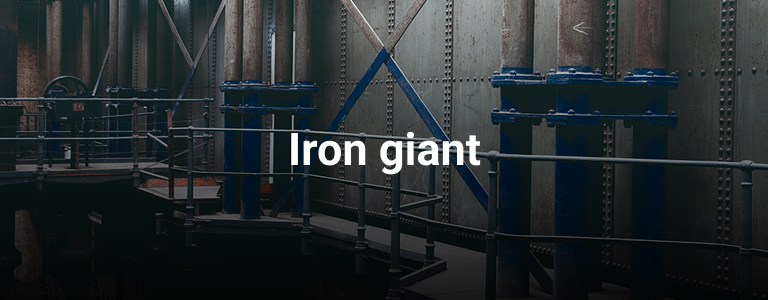
You have walked through the museum halls where you saw the colorful English terracotta pieces covering the entire exterior. You have now moved from that palatial outer shell into the giant’s core: the iron tanks.
These “entrails,” as we affectionately call them, are twelve tanks that could hold up to 72 million liters of water. Since 1978, these tanks have been empty. Today, as we mentioned before, they mainly store millions of historical plans — extremely valuable archives.
What you see behind us now is the large pipe that, more than 100 years ago, brought purified water from Recoleta to these tanks. This is how water entered the building.
Since we are in a high part of the city — as I mentioned before — the water was purified in Recoleta, where the National Museum of Fine Arts now stands. That building, with its machinery, pumped the purified water here.
With the pressure generated by those machines, water rose up this iron column in the center of this space and filled the tanks on the left and right — the iron walls you see. Once full, gravity allowed the water to flow down naturally, supplying the entire city — much like a water tank works in your home, but on a much larger scale.
Today, these tanks are empty, but as I said, the building still hosts cultural and social activities.
For all Argentines, this building is a source of pride: it is a National Historic Monument. Countless urban legends have grown around it, feeding the imagination of Buenos Aires residents and visitors alike.
Every day, someone stops in front of this building to take a photo and wonder what this beautiful palace contains.
What you are seeing now is a Sleeping Giant — once the main water supplier for the city.