




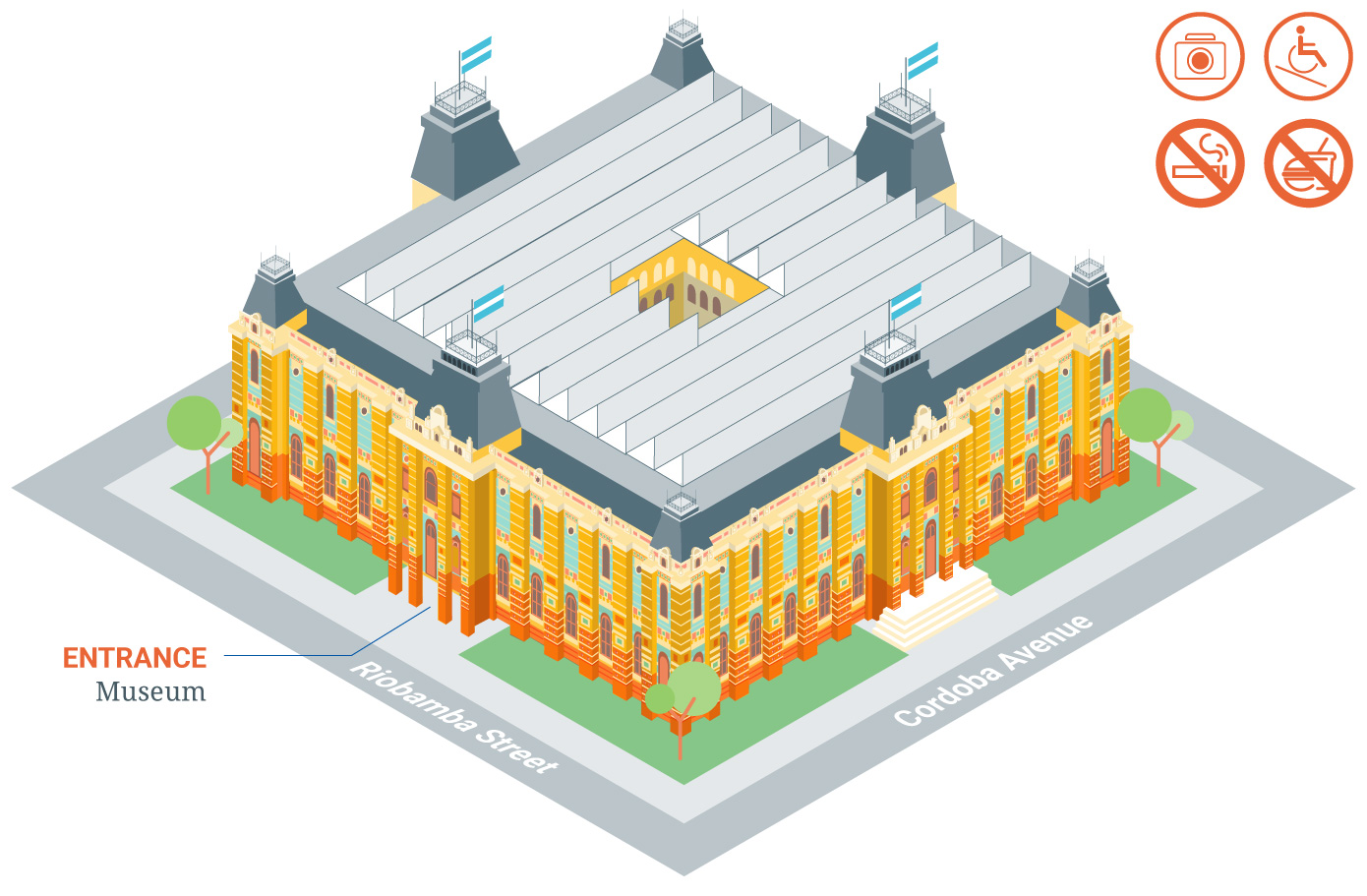
Inaugurated in 1894, this unique Palace is one of the most striking and iconic buildings in Buenos Aires.
It was the City’s first Great Potable Water Distribution Reservoir. A one-of-a-kind masterpiece of art and engineering: on the outside, a majestic terracotta façade; on the inside, one of the largest cast-iron structures on the continent.
In 1989, it was declared a National Historic Monument.


Clad in 300,000 English majolica tiles, it houses a massive Belgian iron structure: three floors of tanks supported by 180 columns, capable of holding more than 72 million liters of water.
It is a true testament to the importance placed on public hygiene and drinking water by the rulers of the time.
1871: The government contracts Engineer John Bateman for the Buenos Aires Water Supply, Drainage, Sewerage and Paving Project.
1872: Initial designs for the Great Distribution Reservoir.
1874: Expansion works for the Recoleta Plant are inaugurated to supply the network and the future Great Reservoir.
1886: Design for the internal iron structure of the Great Reservoir is completed.
1887: Construction work begins.
1888: Use of terracotta for the external architecture is confirmed.
1892: Filling tests are carried out on the iron tanks.
1894: The Great Reservoir becomes operational.
1920: Offices of the National Sanitation Works (OSN) are installed on the ground floor.
1978: It is decommissioned from service. Its spaces are repurposed for administrative and cultural use.
1989: It is declared a National Historic Monument.
• At the request of the Government, the decoration incorporated the National Coat of Arms, the Coats of Arms of the City of Buenos Aires and Rosario, and the Coats of Arms of the fourteen provinces that existed at that time.
• While the wooden joinery was made with cedar from Paraguay, the ironwork was supplied by Scottish foundries.
• Above the main entrance gateway, the year "1887" is displayed, marking the commencement of construction work on the Great Reservoir.
• The polychrome exterior cladding consists of 300,000 terracotta pieces brought from Great Britain.
• The imported terracotta pieces, both glazed and unglazed, were supplied by the firms Royal Doulton & Co. and Burmantofts Co. of Leeds.
• Slates brought from Sedan, France, were used for its domed and mansard roofs.
• The great internal metal structure, assembled like a large meccano set, was brought from Belgium and manufactured by Marcinelle and Coulliet.
